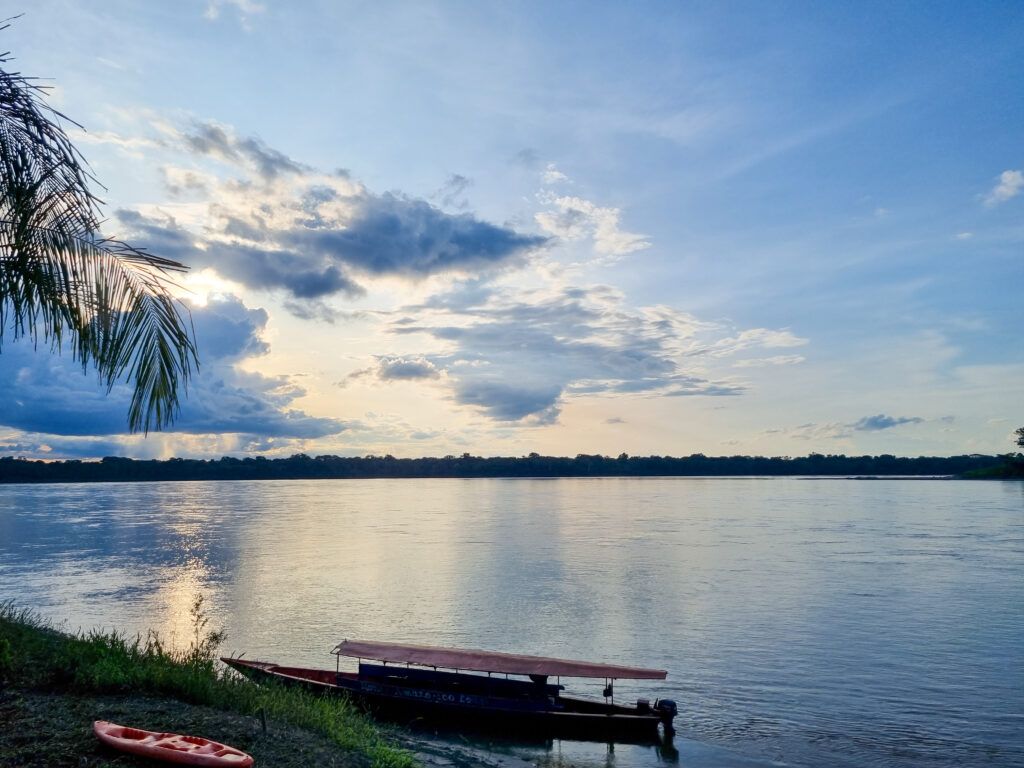
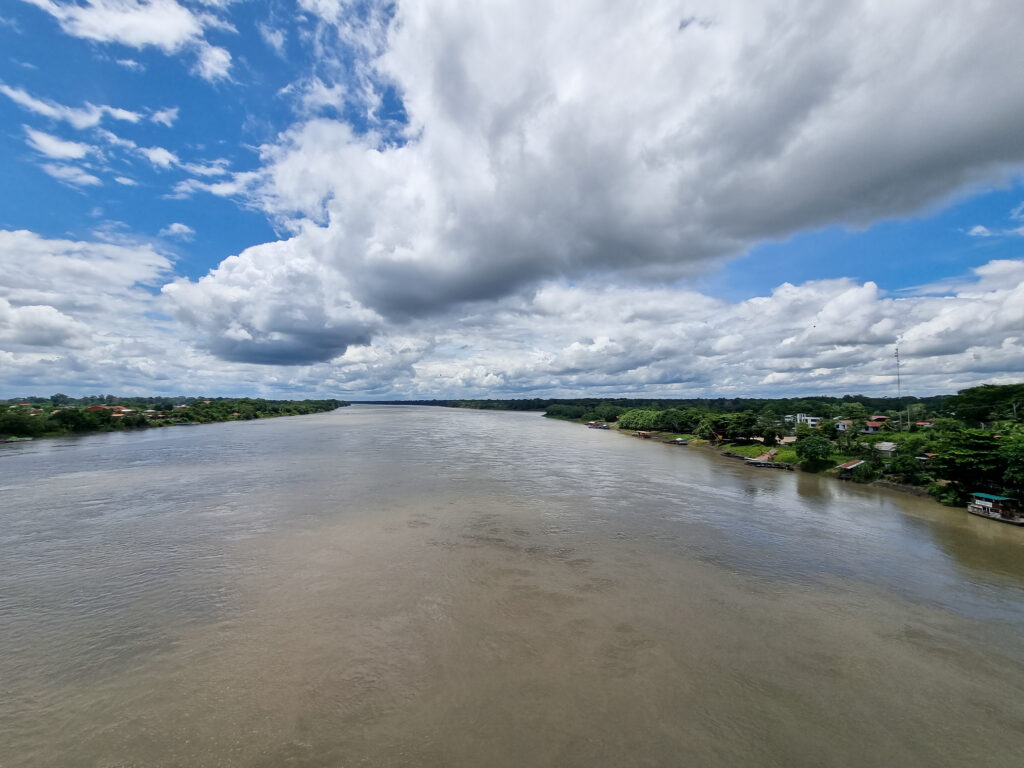
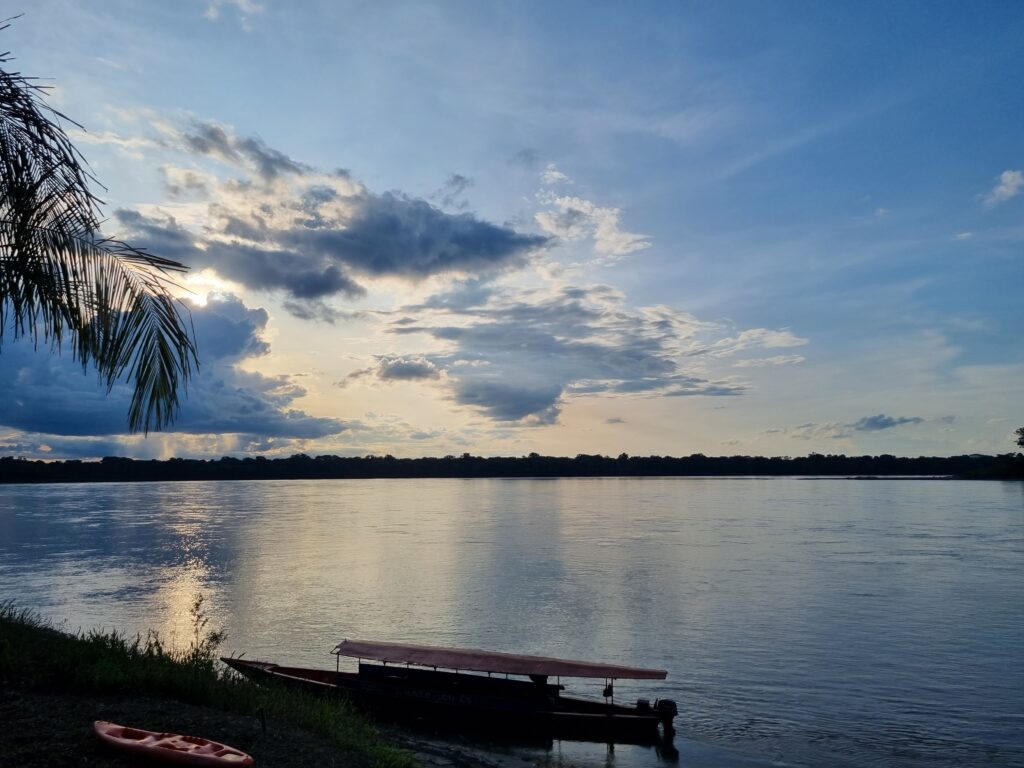
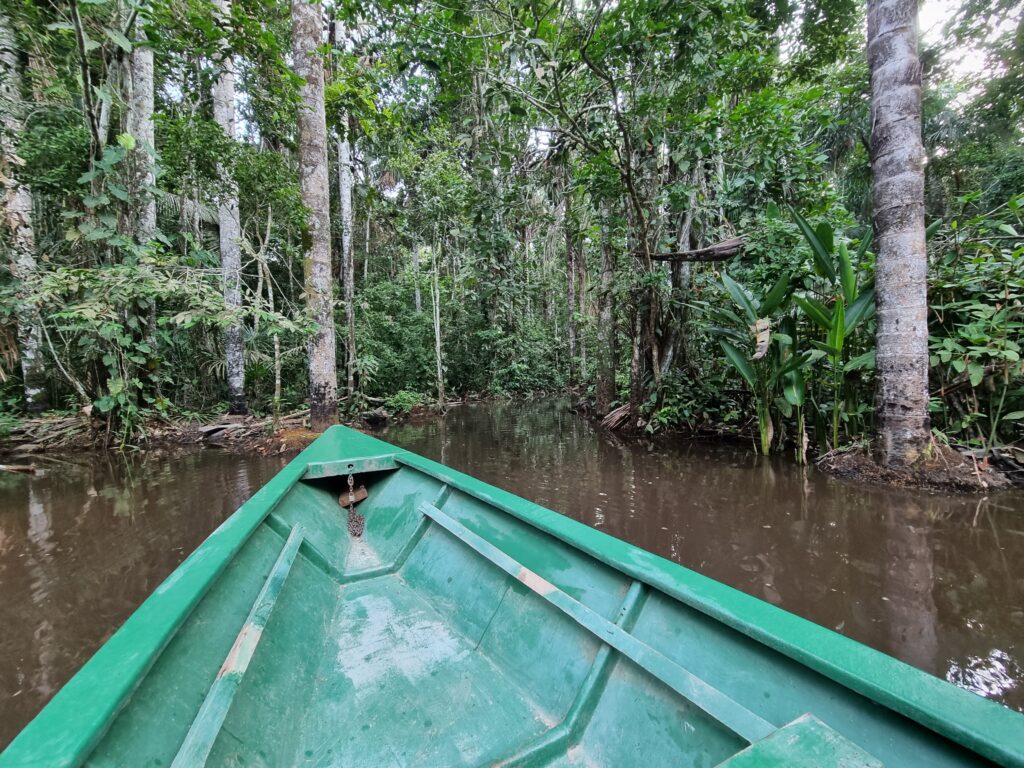
The Peruvian at the helm looked as though he was in his tenth month of pregnancy. His stained old T-shirt was at least two sizes too small, exposing a generous portion of his belly. One hand casually steered the long wooden boat, while the other was busy peeling and chewing on some fruit I’d never seen before. The complete ease with which he guided us back through the jungle toward Puerto Maldonado told me everything I needed to know. This wasn’t his first trip down the river. He was an old hand—a veteran who knew every bend of it by heart.
Confident we were in good hands, I closed my eyes and leaned my head back, letting the warm breeze brush across my face while the occasional splash from the river reached the boat just high enough to cool the back of my neck.
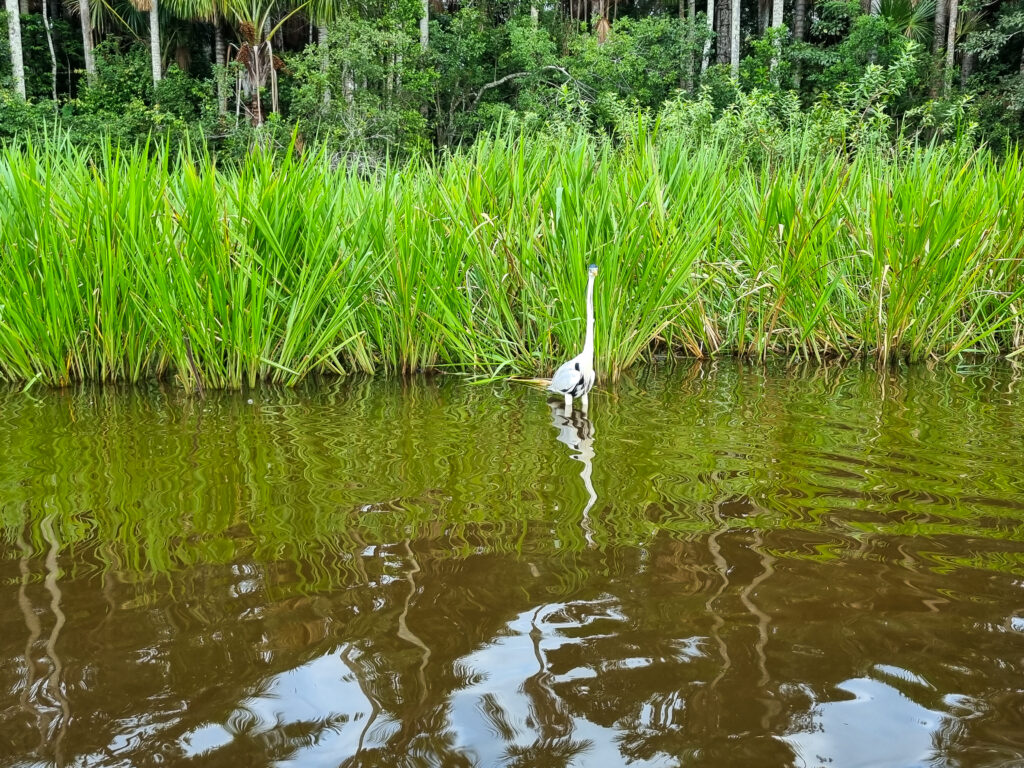
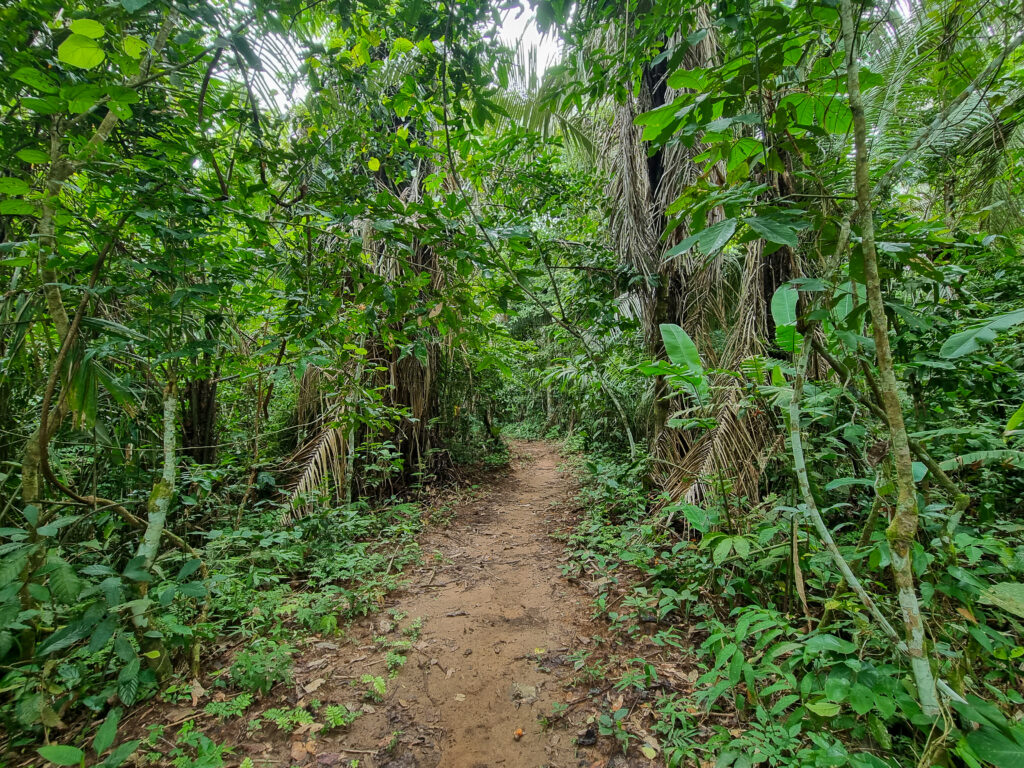
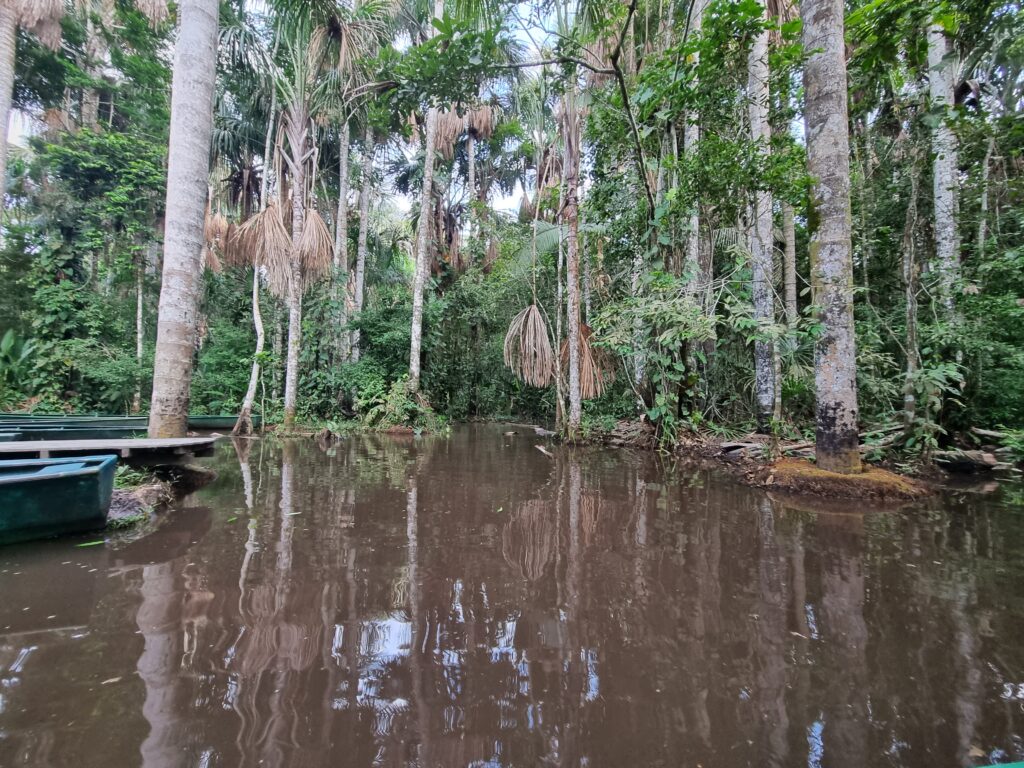
The jungle is unlike anywhere else. The humidity is relentless, a stark contrast to the chilly Andean towns we’d just left behind. And wherever the humidity goes, mosquitoes follow. They attack without mercy, as persistent as Jehovah’s Witnesses knocking on your door. Legs, arms, head, genitals… they don’t discriminate. They break through every defence you put in their way, and absolutely nothing works. Not clothing. Not insect repellent.
Even so, the mosquitoes were nothing compared to the 120-kilogram bloodsucker who’d taken the form of a middle-aged Peruvian. For days, he’d been desperately trying to befriend us while steadily draining every last drop of our patience. His voice echoed across the boat, blending with my friend’s, and although the roar of the engine and the wind in my ears made it impossible to hear the conversation, I had no doubt I’d heard it all before. How he’d earned three university degrees. How his daughter was studying at a private university in Lima. The languages he spoke. The salary he earned. The European women he’d partied with.
Better my friend than me.
I wouldn’t have survived another verbal bear hug from the human anaconda. I’d sooner spend three straight days watching a Sunday relegation battle between Slaven Belupo and Istra, a match guaranteed to finish 0–0 just as surely as the sun would rise tomorrow.
Smiling to myself, I thought I’d dodged a bullet.
I hadn’t.
My friend drove his elbow into my ribs—the universal signal that it was my turn to join the conversation.
“No way you actually stayed in Callao,” the chatty Peruvian blurted out, his face suddenly looking as though he’d seen a ghost.
“You’re lucky to be alive. At the very least, I’m surprised nobody robbed you.”
Even our pregnant-looking boatman stopped chewing his mystery fruit long enough to throw it into the river and make the sign of the cross. The woman sitting opposite me immediately began praying to the Virgin Mary.
Officially, Lima is home to around eight or nine million people. Unofficially, the number is closer to twelve. Out of all its districts, Callao is widely considered one of the worst—if not the worst. They say God looks after fools and drunks. My friend and I have always qualified for both categories.
I let him entertain the rest of the boat with photos from Callao while I leaned back once again, closed my eyes, and quietly celebrated my escape from the human anaconda’s grip. My thoughts drifted back to our very first day in Peru, when we wandered through one of the country’s roughest neighbourhoods completely unaware of the danger surrounding us.
We landed in Lima after dark. Naturally, we hadn’t booked a hostel in advance. Instead, while still at the airport, we typed the word hostel into Google, picked the closest one, and convinced ourselves that the rules we’d grown used to in Europe still applied here. As the taxi driver took us to our destination, I quickly realised that traffic laws were little more than a polite suggestion. Driving in Lima seemed to operate on one simple principle: whoever was more aggressive had the right of way.
When our lucky—or perhaps simply fearless—kamikaze driver finally screeched to a halt and dumped us onto the pavement like a pair of sacks of potatoes, my first thought was that he’d either run out of fuel or the taxi had finally given up. Judging by the condition of the car, both seemed equally plausible. To our surprise, we’d actually arrived. The only problem was that there wasn’t a hostel anywhere in sight, even though the address was correct.
The beers I’d enjoyed on the flight evaporated from my system instantly. A strange feeling began somewhere in my lower back and slowly crept up my spine, telling me we needed to get out of there—and fast. The darkness and silence surrounding us felt deeply unsettling, sharpening every one of my senses. With no better plan, we headed towards the glow of distant streetlights, treating them like a lighthouse guiding us through unfamiliar waters. After a few minutes we reached a main road, where three men were sitting in the middle of the street doing absolutely nothing.
They understood the word hostel. They also understood the universal sign for sleeping—hands pressed together beneath a tilted head. Beyond that, communication fell apart. They looked at us as though we’d shown up with three arms and one leg before pointing us further down the road, clearly surprised to see two tourists wandering around their neighbourhood.
Crumbling houses lined the streets. It was almost dark, and every single front door was protected by heavy metal bars and padlocks. After forty minutes of culture shock, we finally found the hostel. Exhausted and still not entirely sure where we’d ended up, we dropped our backpacks and walked to the nearest shop in search of cold beer. The shop was behind bars too. We couldn’t go inside. The woman behind the counter couldn’t come outside. She slid open a tiny hatch in the metal grille—more like the food slot on a prison cell than the window of a neighbourhood shop—and barked a question at us with military efficiency. We handed over the money. She handed us the beers. The transaction went flawlessly, but I couldn’t help wondering…
Is this really normal in Lima?
We drank a couple of beers on the pavement outside the hostel, where we happened to be the only guests. During that time several local families walked past, staring at us. Their expressions were a strange mixture of surprise and something I’d only later recognise as pity. They probably knew there was a good chance we’d run into trouble sooner or later.
The next morning, after finally getting some sleep, we set off on foot towards the airport, where we planned to catch a bus to Miraflores, Lima’s tourist district. Despite everything we’d later hear about Callao, nothing happened to us that morning.
Only afterwards did I read that the district’s murder rate was roughly twice the national average, that around eleven robberies and assaults were reported every single hour, and that Callao regularly topped Peru’s crime statistics. As luck would have it, the Peruvian government had declared a month-long nightly curfew in Callao during our stay in Lima, beginning at 10 p.m., in an effort to tackle the area’s spiralling crime.
Callao and Miraflores belong to the same city, yet they feel as though they’re on different planets.
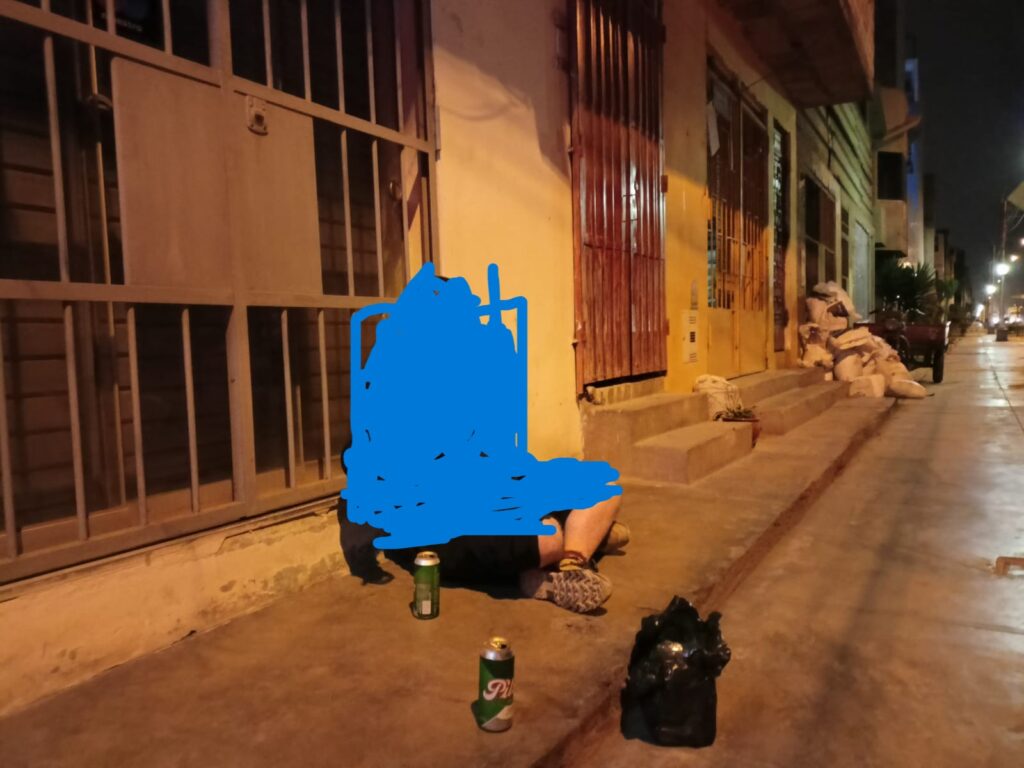
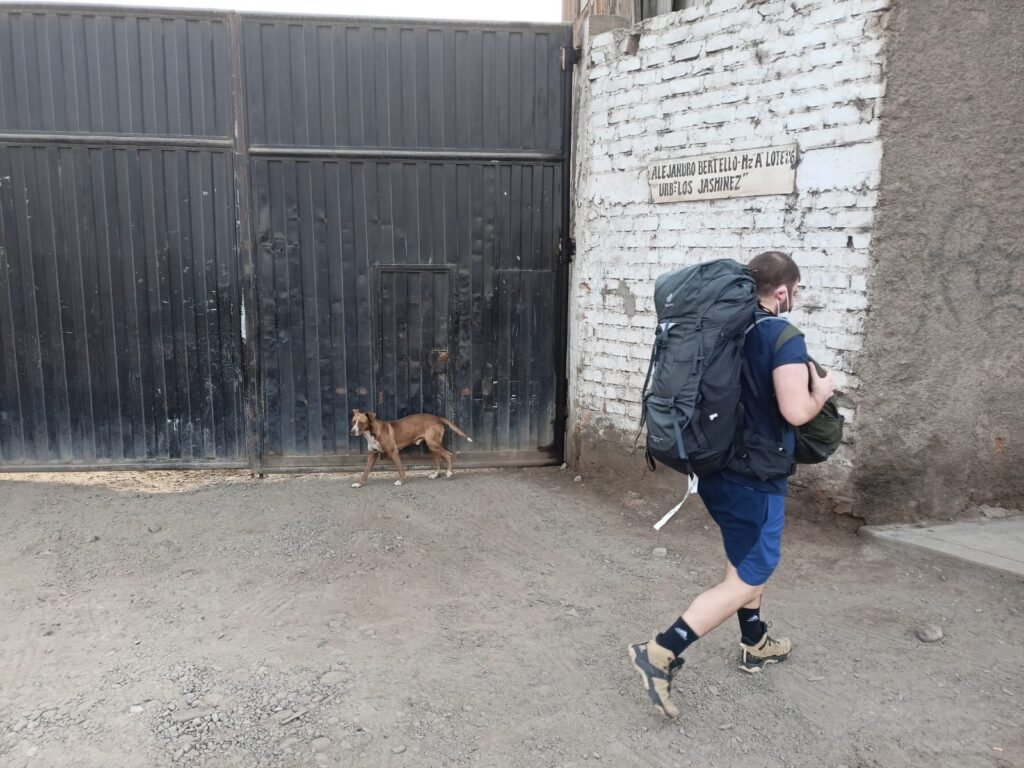
On one side there’s Callao, where poverty is impossible to ignore. The roads are riddled with potholes, rubbish litters the streets, abandoned construction materials lie scattered everywhere, and most of the houses look unfinished—many of them little more than wooden shacks. Padlocks and iron bars dominate the landscape, while police cars and green spaces are nowhere to be seen. Stray dogs rummage through piles of rubbish, their ribs clearly visible beneath their skin. Everything feels dusty, worn out, and grey, as though someone had simply given up on this place, gathered together everyone who didn’t fit the postcard image of tourist-friendly Peru, locked them inside, and thrown away the key.
Then there’s Miraflores.
Just twenty minutes away by taxi, it might as well be New York. Glass office towers rise above immaculate parks filled with smiling tourists. Wide, spotless streets are lined with people dressed in designer brands. Modern luxury apartments overlook the endless Pacific Ocean. McDonald’s, pizzerias, burger joints, expensive jewellery stores, high-end boutiques—everything about the place feels polished and prosperous.
The day before I’d been in Berlin, yet not a single neighbourhood there came close to matching the cosmopolitan atmosphere of Miraflores. The gap between wealthy Miraflores and impoverished Callao is staggering. Two completely different worlds sharing the same city.
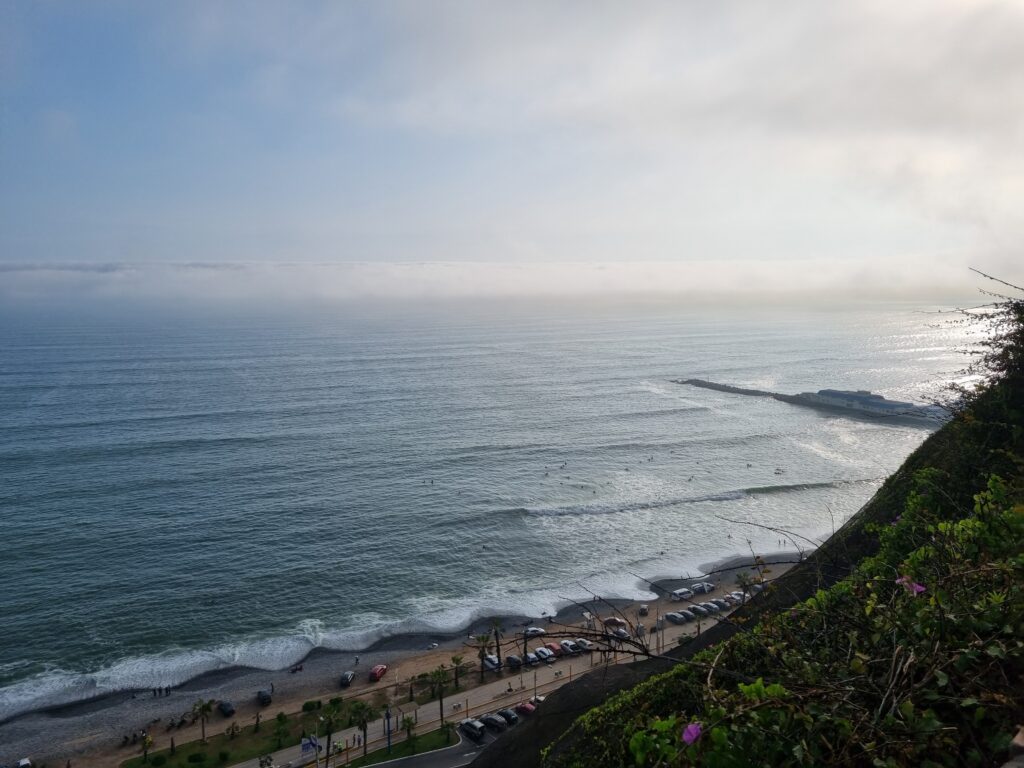
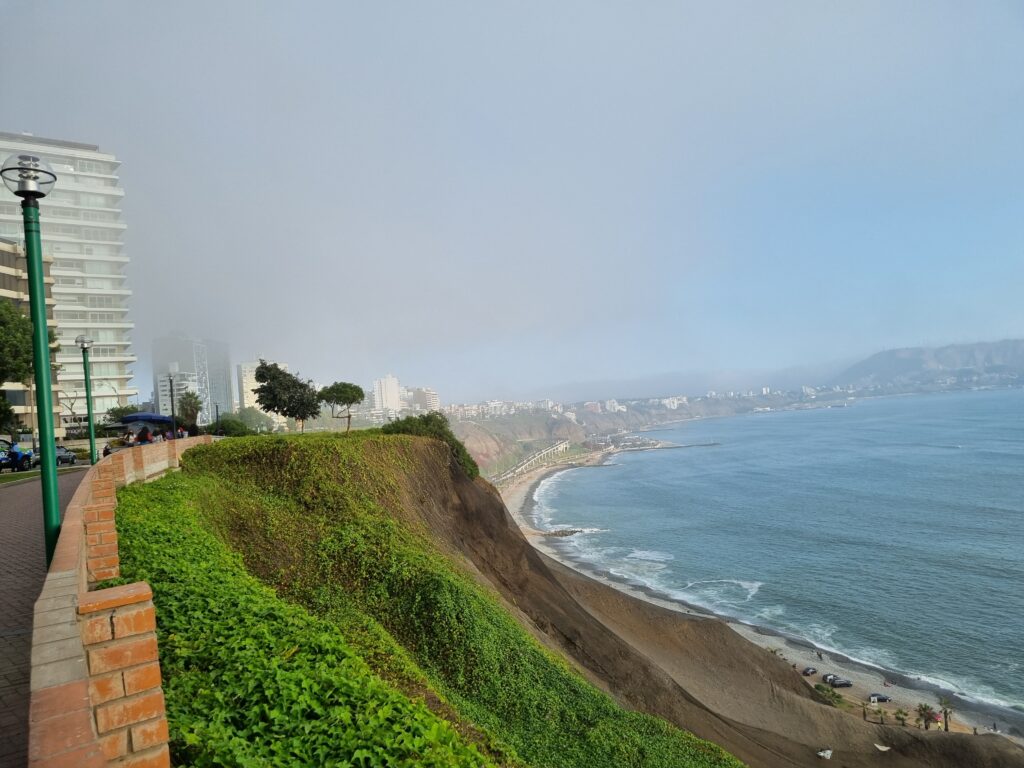
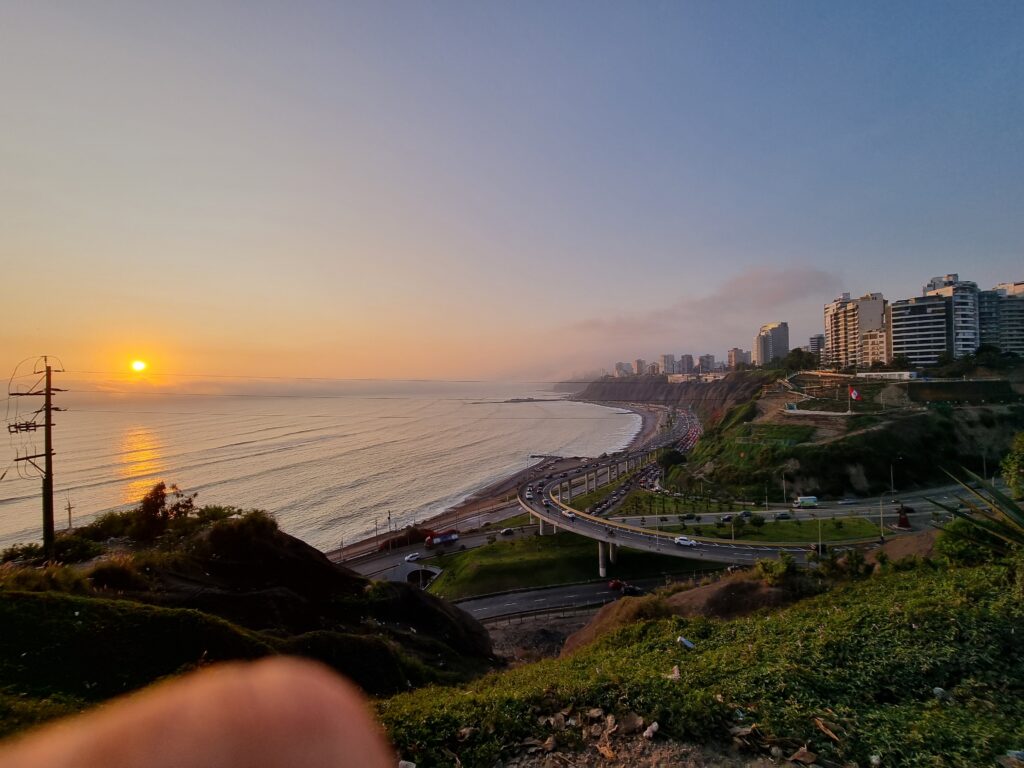
After walking for several hours, I eventually found a quiet viewpoint overlooking the coastline, where surfers were trying to tame the Pacific’s waves. From a distance, they looked like tiny black brushstrokes dancing across a vast blue canvas.
Around me stood luxury apartment buildings wrapped in glass, while cars worth more than I’d probably earn in years glided silently through the streets. Everyone looked happy, like extras in a luxury real estate advertisement. It struck me that just twenty minutes from where I was sitting, people were killing one another over a few banknotes tucked into a pocket. I sipped my beer as the sun slowly melted into the Pacific, beginning its long journey towards New Zealand. Once it disappeared below the horizon, it became impossible to tell where the sea ended and the sky began. I may not have felt safe in Callao. But I knew I didn’t belong in Miraflores either.
From Peru’s own Beverly Hills—Miraflores—it took us two or three hours on foot to reach the bus terminal, where our ride to Cusco was waiting. It was fascinating to watch the city change as we moved farther away from the centre. Traffic was so heavy that, in some places, we were walking faster than the cars. It gave street vendors the perfect opportunity to weave between the vehicles, selling cold drinks to drivers trapped in the endless congestion.
As we made our way through Lima’s concrete jungle, we were stopped by a beautiful young Peruvian woman selling chicha—a reddish corn-based drink popular throughout Latin America. Half a litre cost just one sol. She was impossible to say no to.
Not only was she the first—and, as it turned out, the last—person in Lima who spoke English, but her smile, revealing a row of perfect white teeth, and the playful sparkle in her eyes could have melted even the coldest heart. She had dark skin, long jet-black hair, and almond-shaped brown eyes. I remember thinking there wasn’t a single drop of European blood in her veins..
Later in the trip, I noticed a striking difference between women from the high Andes and those who had spent their lives at lower altitudes, both in appearance and in the way they carried themselves.
We sat down on a nearby wall and exchanged stories, two completely different worlds colliding for half an hour. She had no idea where Croatia was, but her dream was to visit Europe one day, despite never having left Peru. I still wonder where life took her.Is she still standing by that same road, selling chicha to thirsty passers-by? Or did she manage to fulfil her dream and make it to Europe? The very same Europe I keep trying to escape like the Mamić brothers trying to escape the Croatian justice system.
I was abruptly interrupted by a slightly hyperactive young man shouting something after us. Judging by his nose, he’d clearly sampled a little too much of his own merchandise, but he showed no signs of aggression. He spoke nothing but Spanish, while we spoke just about everything except Spanish. Still, where there’s a will, there’s a way. It didn’t take long to figure out that he sold cocaine. Surprisingly, though, he wasn’t trying to sell us any. All he wanted was a photo with two gringos to show his wife who he’d bumped into.
There I was, sporting a beard that would’ve made Robinson Crusoe proud after a few difficult years on the island, standing next to my friend—a two-metre-tall white giant. To most Peruvians, we were basically a travelling circus. Beards are uncommon, and anything over 170 centimetres is considered seriously tall. After my friend and our newly acquired cocaine dealer exchanged… let’s call them anti-social media contacts, he started scrolling through the photos on my friend’s phone. He stopped at the pictures we’d taken in Callao the night before.
“I wouldn’t go into Callao during the day, let alone at night,” he said, offering us half of his roast chicken.
“You were incredibly lucky.”
We sat with him in a small park while waiting for our bus. He chased a few questionable characters away from us, introduced us to a few others, and although he was clearly operating on the wrong side of the law, I couldn’t help but feel strangely safe around him. It was fascinating to watch him and his friends go about their business—right up until it was time for us to say goodbye.
A few minutes later, I climbed aboard the bus that would carry us on a twenty-six-hour journey to the former capital of the Inca Empire—Cusco. I remember thinking that I’d been in South America for less than twenty-four hours, and even if I’d flown home the following morning, the journey would’ve already been worth it.